Ch341a Usb Driver Zip
You better have a laptop or a 2nd PC to use the CH341A with.But yes, you can remove the Chip after Boot and overwrite it using the prgrammer and the started PC wihtout Bios-Chip! The Bios is only used at the beginning of the PC-Start Process.
If the flashed Bios is non-functional, though, The PC won't start anymore. Be sure to make a backup of your former Bios. You can order a Chip with that particular Bios afterwards or flash the backup-file with an other PC.If you need a CH341A I still have one and can ship it from Germany.
Related Searchesusb Programmer Ch341a Software
CH341A is an USB interface chip that can emulate UART communication, standard parallel port, memory parallel port and synchronous serial (I2C, SPI). The chip is manufactured by Chinese company. CH341A is used by some cheap memory programmers. The IC is somehow limited in this configuration, because the programmer makes use only of the SPI and I 2C interface and leaves a lot of pins unconnected. A popular device is the black that you can buy for 2 to 5 USD.The problem with these devices is that you get them without any documentation or software. Drivers are available from manufacturer's website (but the site is written in Chinese). Also, some source codes are available from manufacturer.
Driver description Download driver USB-EPP/I2C. CH341A Driver version 2.2.2009.6 for Windows XP, Windows Vista, Windows 7, Windows 8, Windows 8.1, Windows 10 32-bit (x86), 64-bit (x64). Use the links on this page to download the latest version of USB-EPP/I2C. CH341A drivers. All drivers available for download have been scanned by antivirus program.
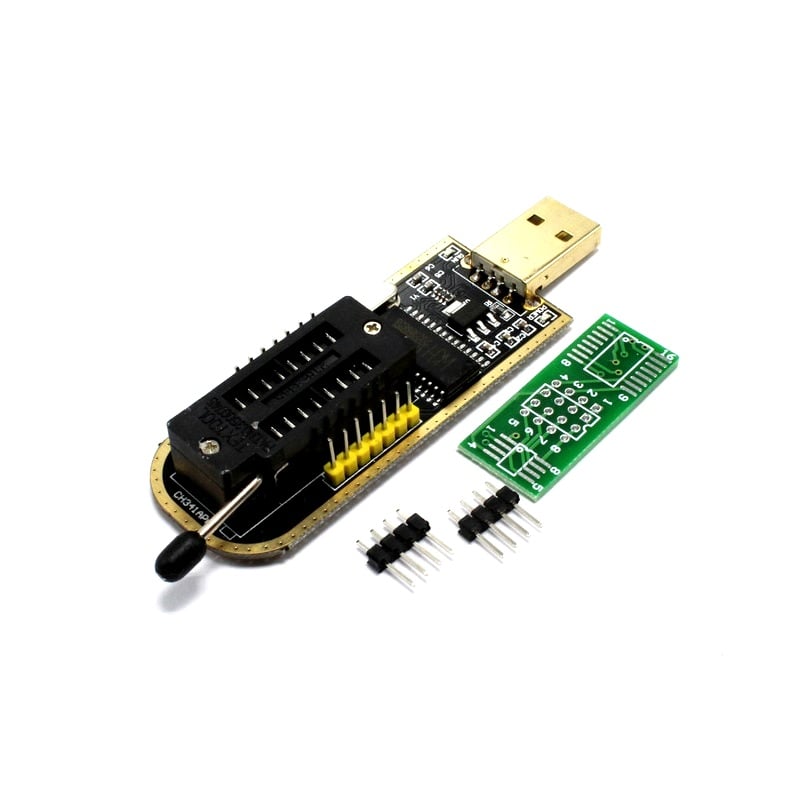
There are open source applications that support this programmer. But, first of all, let's have a look at the hardware.Photo of the black CH341A Mini ProgrammerA quick look at the board reveals the main electronic parts used: CH341A, a 12 MHz crystal required by the chip, a 3.3V regulator, two 7 pin headers and the ZIF ( zero insertion force) socket. The programmer can be bought with additional sockets and adapters, some of them with voltage shifting circuits.After some searching I found a schematic of a CH341A based programmer, but it wasn't exactly right and complete.
It didn't have the pinheaders on the sides of the ZIF socket which I wanted to know what they are for. I took the multimeter and started to trace lines on the programmer PCB until I got a complete schematic. The schematic is quite simple, based on datasheet.Schematic of the black CH341A Mini ProgrammerI also found (a seller on AliExpress). Their offered a the PCB design of the device (only top side, however).CH341A Mini Programmer PCB (by WAVGAT/AliExpress)Now, let's return to the schematic and analyze it a bit. The chip is powered from 5V, so its I/O ports will also use 5V. Basically this is a 5V device.
The problem is that any memory you fit in the socket will be powered from 3.3V. And this seems to be the only function of the 3.3V regulator (besides the 3.3V pin on the SPI connector). I don't know why the designer even used a regulator, if it didn't provide a switch to choose between 3.3V or 5V levels and supply.By, we can see that the manufacturer recommended to connect a 0.47 uF capacitor between RSTI (pin 2) and VCC for improved stability. There is none on this board.Anyway, I used the device with I2C EEPROMS (3.3V and 5V) compatible and also SPI FLASH memories (3.3V devices) without any issues.
For improved reliability and to avoid burning memory chips, I highly recommend using a level shifter. In order to turn this programmer into a 3.3V device, you could cut the 5V line from VCC pin (28) and tie it to the 3.3V output from regulator. You will also need to connect V3 pin (9) to VCC (3.3V).
User johnmx from EEVblog Forum has succeeded in.Note that the device works as a programmer only if ACT# pin is connected to ground via a resistor. That's why you should put a jumper across pins 1 and 2 of the UART connector. Otherwise the device will be recognized as a standard USB to serial converter.The manufacturer of CH341A provides a lot of useful things on the product page.
That was a difficult question. I took the multimeter and measured (again) the voltages on the idle I2C bus. I unplugged the programmer and tried to measure resistance between I2C bus pins and power line (3.3V and 5V). Nothing conclusive. So I returned to datasheet. Here is what it says in the Chinese PDF at page 3, section 4.2, pin 24 of 341A (translated with Google): 'Chip function configuration output, built-in pull-up resistor, can be connected to the serial EEPROM configuration chip SCL pin'. The pull-ups are therefore built-in.
Ch341a Programmer Software Download
And look at the schematic again: only SDA is connected to the LED. What would be pulling SCL up if it weren't the built-in resistors? AnonymousHi, reading chinese datasheet for CH341 and at end of chapter 5.2 硬件说明 (Hardware description) is stated:CH341芯片支持5V电源电压或者3.3V 电源电压。当使用5V 工作电压时,CH341 芯片的VCC 引脚 输入外部5V 电源,并且V3 引脚应该外接容量为0.01uF~0.1uF 的电源退耦电容。当使用3.3V 工作电压时,CH341 芯片的V3引脚应该与VCC引脚相连接,同时输入外部的3.3V电源,并且与CH341芯片相连接的其它电路的工作电压不能超过3.3V。It can be translated:The CH341 chip supports a 5V supply voltage or a 3.3V supply voltage. When using a 5V supply voltage, the VCC pin of the CH341 chip inputs an external 5V power supply, and the V3 pin should be externally connected with a power supply decoupling capacitor of 0.01uF to 0.1uF. When working with 3.3V voltage, the V3 pin of the CH341 chip should be connected to the VCC pin, and an external 3.3V power supply is input, and the CH341 core is connected.The operating voltage of other circuits connected to the chip cannot exceed 3.3V.As far as I understand, that mean, that chip have internal 3.3V regulator and IO pins are NOT 5V tolerant. It mean, it always use 3V3 for communication with eeprom.