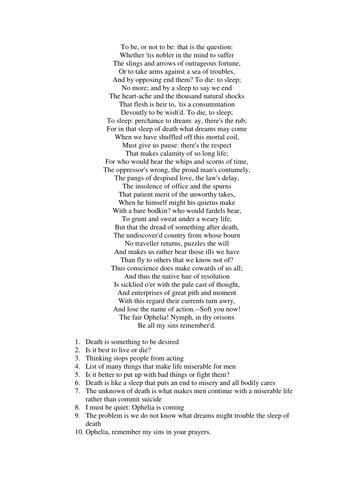
To Be Or Not To Be
‘This is Not Going to Be the Country of White People’ Jared Taylor, American Renaissance, May 1, 2019 Jared Taylor and PK congratulate Congresswoman Ilhan Omar on making her position clear.
OUGHT (TO) / IT'S A GOOD IDEAOught (to) acts very much like a modal except that it is used with an infinitival complement. The modal or the infinitive clause can be negated without much difference in meaning. The question form is not used very much. Ought expresses weaker advisability than have (to).OUGHTINFINITIVAL FORMYou oughtto use your car less.You ought notto use your car so often.(not advisable)You oughtto not use your car so often.(advisable not to use it.)Ought youto use your car so often?It's a good ideato leave your car in your garage.
Advantage system care full. HAVEHave (to), a semi-modal, expresses necessity (strong advisability). However, it is unlike other modals in its use of do as an auxiliary and its use of an infinitival complement.
To Be Or Not To Be That Is The Question
Negating the modal results in a different meaning from negating the infinitive clause.HAVEINFINITIVAL FORMYou haveto use other forms of transportation occasionally.You do not haveto drive.(not required – You decide.)You haveto not drive everyday.¹(required not to – Don't)Do you haveto drive everyday?It is necessaryto drive less. HAD BETTERHad better refers to the immediate future and is used to give strong advice (in some cases threatening advice!) It is more urgent than should or ought to. The had in had better does not behave like other auxiliary verbs.FORMYou had better close the door open or (else) all the heat will go out.NEGATIVEYou had better not close the door or the cat will be trapped inside.NEGATIVE QUESTIONHad n't you better close the door? (I think you'll agree you had better.)TENSE RESTRICTED TO FUTUREYou had better close the door. (future)You had to close the door. (past requirement or necessity)I thought it was a good idea to close the door. (reworded to past).
HAD BETTER ERRORSHad does not change form for tense or person. It always refers to the near future. Had is followed by not in a negative question but not in an positive question. Had better is always followed by the plain form (base) verb.HAD + BETTER + PLAIN FORM — ONLY!.You have better close the door open or.He has better close the door open or.You had better to close the door open or.You had better closing the door open orHAD BETTER → NOT. You had n't better close the door or the cat will be trapped.POSITIVE QUESTION.Had you better close the door?
(not used).Had you better not close the door? (not used)TENSE NOT ADJUSTABLE WITHIN ANOTHER CLAUSE.I thought you had better close the door.(I thought you needed to / should have / ought to have closed the door.).They had better leave before the hurricane arrived.(They needed to leave before the hurricane arrived.). MODAL / MODAL-LIKE AUXILIARIESExpressing advisability depends on social situations such as age (younger v. Older), relationship (acquaintance v. Family) working relationship (employee v.
Boss, student v. Teacher, client v. Salesperson) and sovereignty/authority (citizen v.
King/leader).WEAK— LESS DIRECT / PEERYou should walk more often. (plain form verb)You ought to walk a more often. (infinitive)Shouldn't you walk more often?STRONGER—MORE DIRECTYou had better walk more often.You really ought to walk more often. Hadn't you better walk more often?. Oughtn't you walk more often?STRONGEST—MOST DIRECT / AUTHORITYYou must walk more often.You have to walk more often.
OTHER EXPRESSIONSOther wording for advisability includes expressing personal opinion (manner, disposition, feeling, perspective), reasoning (logic, rules, ethics, norms), questions (inviting others to express opinion) and negative questions (persuading others to agree).WEAK— LESS DIRECT / PEERIt's a good idea to walk more often.Why don't you walk more often?Don't you think you should walk more often.STRONGER—MORE DIRECTI suggest that you walk more often.I am asking/urging you to walk more often.For your own good, walk more. (health)Don't you think that you ought to walk more often?STRONGEST—MOST DIRECT / AUTHORITYIt's necessary / imperaative / required that you walk more.I demand / order / insist that you walk more.
PAST NECESSITY / LATE ADVICENeeded to or had to express the idea that something was necessary or required. Had to expresses an actual past event. With these words, we express opinion on the most important items requiring attention or concern.We needed to protect the environment.(It was needed. Maybe we did. Maybe we didn't.)We had to protect the environment.(It was required. Likely, we did.).We must have protected theenvironment. (inference)It was necessary that we protect the environment.(It was required.
Likely, we did.).

Adults now say it is not necessary to believe in God to be moral and have good values (56%), up from about half (49%) who expressed this view in 2011. This increase in the share of the population that has no religious affiliation, but it also is the result of changing attitudes among those who do identify with a religion, including white evangelical Protestants.Surveys have long shown that religious “nones” – those who describe themselves religiously as atheist, agnostic or “nothing in particular” – are more likely than those who identify with a religion to say that belief in God is not a prerequisite for good values and morality. So the public’s increased rejection of the idea that belief in God is necessary for morality is due, in large part, to the spike in the share of Americans who are religious “nones.”Indeed, the of Americans who say belief in God is unnecessary for morality tracks closely with the growth in the share of the population that is religiously unaffiliated.
In the 2011 Pew Research Center survey that included the question about God and morality, religious “nones” constituted 18% of the sample. By 2017, the share of “nones” stood at 25%.But the continued growth of the “nones” is only part of the story. Attitudes about the necessity of belief in God for morality have also changed among those who do identify with a religion. Among all religiously affiliated adults, the share who say belief in God is unnecessary for morality ticked up modestly, from 42% in 2011 to 45% in 2017.Among white evangelical Protestants, 32% now say belief in God is not necessary to have good values and be a moral person, up from 26% who said this in 2011.
To be sure, most white evangelicals still say belief in God is necessary for morality. But the share who say belief in God is a necessary underpinning of being moral has declined from 72% to 65% in just six years.Religious “nones” themselves, in addition to growing as a share of the population, have simultaneously become more likely to reject the idea that believing in God is necessary for morality. In 2017, 85% of religious “nones” say belief in God is unnecessary for morality, up from 78% who said this in 2011.The trends in opinion on this question also point in the same direction among white mainline Protestants, black Protestants and white Catholics. Recent changes among these groups, however, have not been statistically significant.